Running a business in Perth comes with a long list of operational demands, and electrical infrastructure sits near the top of the list for most commercial properties. Unlike residential work — where a faulty power point is an inconvenience — electrical issues in a commercial environment translate directly to downtime, compliance exposure, and in some cases, serious safety incidents. Getting the right qualified commercial electrician involved before problems escalate is one of the most practical steps a business owner or property manager can take.
This guide covers what distinguishes commercial electrical work from residential, what to look for when selecting a commercial electrical contractor, the key services commercial properties typically require, and the compliance landscape every Perth business owner should understand.
What Makes Commercial Electrical Work Different
Commercial electrical systems are fundamentally more complex than residential systems. The scale, load requirements, regulatory obligations, and technical specifications involved require a licensed electrician with specific commercial experience — not just a residential generalist.
Key distinctions include:
- Three-phase power — most commercial premises operate on three-phase supply rather than the single-phase supply used in residential properties. Three-phase systems require specific expertise in load balancing, distribution board configuration, and switchboard work.
- Higher load requirements — commercial equipment including HVAC systems, industrial machinery, commercial kitchen equipment, and lighting infrastructure draws significantly more current than residential loads.
- Compliance obligations — commercial properties are subject to requirements under the WA Electricity (Licensing) Regulations, Australian Standards, and in specific sectors, additional industry standards.
- Emergency lighting and exit signs — legally required in most commercial occupancies, with specific installation, testing, and maintenance obligations.
- Safety switch (RCD) requirements — commercial switchboards must meet specific RCD protection standards that differ from residential requirements.
Key Services a Commercial Electrician in Perth Should Provide
A qualified commercial electrician in Perth should offer a comprehensive range of services covering installation, maintenance, and compliance across the full scope of commercial electrical systems. The most in-demand services include:
Switchboard Upgrades and Maintenance
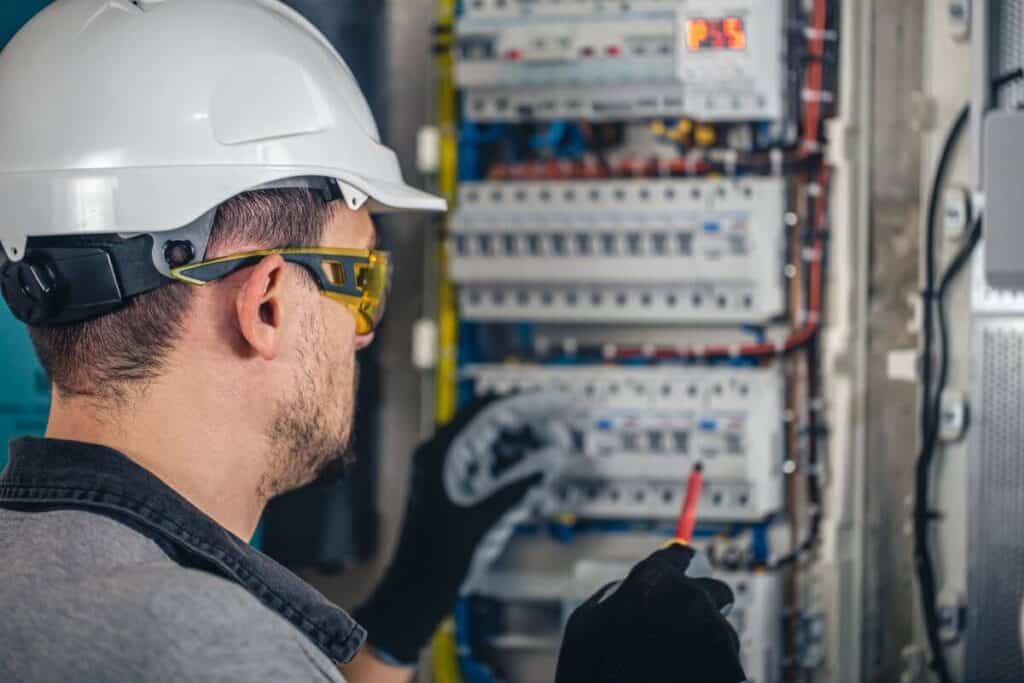
Commercial switchboards are the heart of a building’s electrical system. Ageing switchboards — particularly those still fitted with ceramic fuses rather than modern circuit breakers and RCDs — are both a safety risk and a compliance concern. A switchboard upgrade ensures the installation meets current AS/NZS 3000 wiring rules, provides appropriate fault protection, and has adequate capacity for current and future load requirements.
Emergency Lighting and Exit Sign Installation
Under the National Construction Code (NCC) and Building Code of Australia (BCA) as adopted in WA, most commercial occupancies are required to have compliant emergency lighting and exit signs. These systems must be tested every six months and annually, with test results documented. A commercial electrician with emergency lighting experience can install, maintain, and provide the required compliance certificates.
LED Lighting Upgrades
Commercial LED lighting upgrades are among the most cost-effective investments available to Perth businesses. Modern LED fittings deliver equivalent or superior illumination at 50–80% of the energy consumption of fluorescent or metal halide alternatives. For businesses with high lighting loads — warehouses, manufacturing facilities, retail spaces — the payback period for a LED retrofit is often under two years.
Test and Tag
Portable Appliance Testing (PAT) — commonly called test and tag — is a legal requirement in most commercial work environments in WA. Under WA’s Occupational Safety and Health Regulations, portable electrical equipment used in the workplace must be regularly inspected and tested. The testing interval varies by environment risk level, from three months in construction environments to five years in offices.
Data Cabling and Communications Infrastructure
Commercial electricians with ACMA cabling registration can also carry out the structured data cabling work that underpins commercial IT infrastructure — from simple office network cabling to comprehensive multi-floor installations.
Understanding Commercial Electrical Compliance in WA
Western Australia’s electrical licensing and compliance framework is administered by EnergySafety WA (now part of the Department of Energy, Mines, Industry Regulation and Safety — DEMIRS). Licensed electricians working on commercial installations must hold the relevant WA electrical contractor licence, and all notifiable electrical work must be documented and certified.
For business owners, the key compliance touchpoints include:
- Certificates of Electrical Compliance (CEC) — required for all prescribed electrical work. Your electrician must provide this documentation on completion of notifiable work.
- Residual Current Device (RCD) protection — commercial switchboards must comply with the applicable WA requirements for RCD protection of socket outlets and other circuits.
- Emergency lighting and exit sign compliance — testing and documentation obligations under AS/NZS 2293 must be met and records retained.
- Test and tag compliance — portable appliance testing must meet the applicable code requirements for your industry and environment.
- Periodic inspection and testing — some commercial tenancy agreements and insurer requirements specify regular inspection and testing of electrical installations.
What to Look For When Selecting a Commercial Electrical Contractor
Not all electricians are equally equipped to handle commercial work. When evaluating contractors, consider the following:
Licence verification — confirm the contractor holds a current WA electrical contractor licence (A-class for unrestricted work). This is verifiable through the DEMIRS licence register.
Commercial experience — ask specifically about relevant commercial projects. An electrician with extensive residential experience may lack familiarity with three-phase systems, commercial switchboard configurations, or the compliance documentation requirements of commercial work.
Public liability and professional indemnity insurance — essential for any commercial engagement. Request evidence of current coverage.
Compliance documentation — a reputable commercial electrician will issue Certificates of Electrical Compliance as a matter of course and will be able to explain the documentation process upfront.
Availability for emergency response — commercial operations don’t operate on a nine-to-five schedule. An electrical contractor that can respond outside business hours to critical faults is significantly more valuable than one that cannot.
Planning Electrical Infrastructure for Commercial Fitouts
New commercial fitouts in Perth — whether fitting out a new lease or reconfiguring an existing space — require careful electrical infrastructure planning from the outset. Common mistakes that result in expensive remediation work include:
- Undersized switchboards that lack capacity for the planned load — future-proofing the switchboard at installation is always cheaper than a retrofit.
- Insufficient power outlets at workstation and equipment locations — a common office fitout issue that leads to extension lead proliferation (itself a compliance risk).
- Overlooking data cabling infrastructure during the fitout phase — cable runs are far cheaper to install before walls are finished and ceilings are closed.
- Failing to account for emergency lighting requirements during the design phase — retrofitting emergency lighting after fitout completion is significantly more expensive.
When to Call a Commercial Electrician Immediately
Some electrical issues in commercial environments require immediate professional attention. Don’t delay in engaging a licensed electrician when you observe:
- Circuit breakers tripping repeatedly — indicates a fault or overloaded circuit that requires diagnosis.
- Burning smell from switchboards, power outlets, or electrical equipment.
- Flickering or intermittent lighting — may indicate loose connections or an impending fault.
- Partial power loss to sections of the building — suggests a fault in the distribution system.
- Visible damage to wiring, outlets, or electrical equipment.
- Failed emergency lighting or exit signs — a direct compliance issue requiring prompt rectification.
Conclusion: Commercial Electrical Is Not the Place to Cut Corners
Commercial electrical infrastructure underpins everything a business does. Choosing the right contractor — licensed, experienced, well-insured, and familiar with WA’s compliance framework — protects your business from downtime, safety incidents, and regulatory exposure. The incremental cost of engaging a properly qualified commercial electrician is invariably less than the cost of rectifying work done by someone who lacks the relevant experience or credentials.
If your Perth business is planning a fitout, upgrade, or requires ongoing electrical maintenance and compliance support, take the time to verify credentials, ask for references from comparable commercial projects, and confirm the contractor can provide the compliance documentation your tenancy or insurer requires.