There’s a meaningful difference between a garden that happens and a garden that’s designed. The former is the result of accumulated decisions made over time — a tree planted here, a garden bed added there, a patio laid when the budget allowed. The latter is the product of a coherent vision, executed with intention.
Garden landscape design is the discipline of translating a homeowner’s vision — their lifestyle, aesthetic preferences, and practical needs — into a cohesive outdoor environment that works on every level. It involves far more than choosing plants. Good garden design considers the architecture of the home, the movement of people through the space, the quality of light at different times of day, the relationship between hardscape and soft planting, and how the garden will evolve over the years. If you’ve been wondering why your backyard doesn’t quite feel right despite multiple attempts to improve it, the answer is almost always the same: it needs a proper design.
What the Garden Landscape Design Process Actually Looks Like
For many homeowners, the design process is the most unfamiliar part of a landscaping project. It’s worth understanding what it involves, because the quality of the design phase directly determines the quality of the finished result.
It typically begins with a detailed site analysis. A qualified landscape designer or garden designer will assess the site’s dimensions and topography, its aspect and sun path, existing vegetation (including what’s worth retaining and what needs to go), soil type and drainage characteristics, and how the outdoor space connects to the interior of the home. This analysis is the foundation of every design decision that follows.
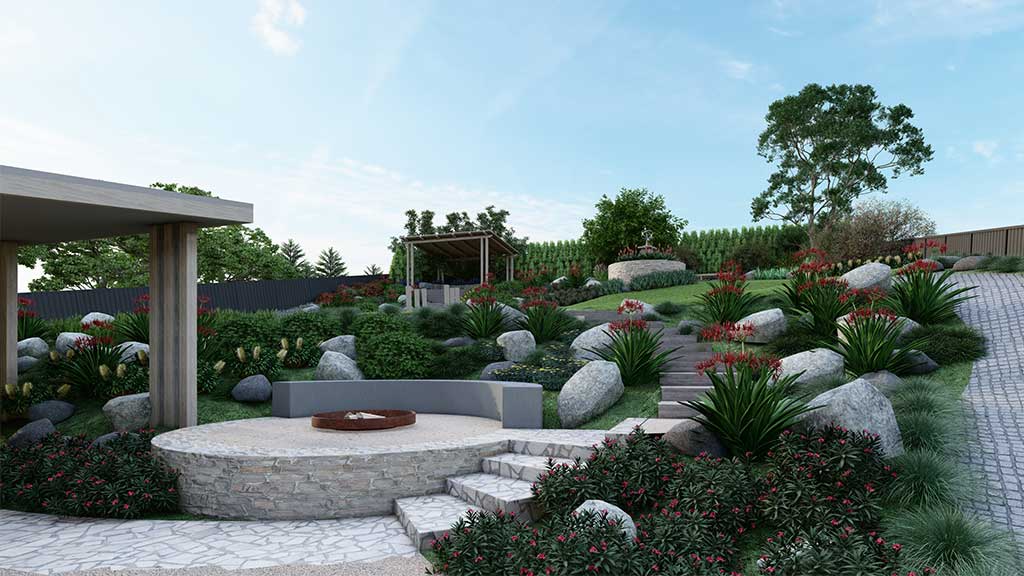
From there, the designer develops a concept — usually presented as a scaled plan showing the layout of hardscape elements, garden zones, planting areas, and any structures like pergolas, retaining walls, or water features. The concept should explain the logic behind each decision: why this paving material in this area, why these plants in this bed, why the path takes this route rather than that one.
For more complex projects, this is where 3D visualisation technology becomes genuinely valuable. Being able to see a photorealistic rendering of the finished garden before any work begins allows homeowners to make informed choices about materials, proportions, and plant combinations. It also helps avoid the costly surprises that arise when a design that looked good on a two-dimensional plan doesn’t translate as expected into three-dimensional reality.
The Principles Behind Great Garden Design
Good garden landscape design is guided by a set of underlying principles that apply regardless of style, scale, or budget. Understanding these principles helps explain why some gardens feel effortlessly beautiful while others, despite significant investment, never quite come together.
Unity and cohesion: A successful garden feels like a whole, not a collection of parts. This is achieved through repeated use of materials, colours, and plant forms that create visual rhythm and continuity throughout the space.
Scale and proportion: Garden elements need to be sized appropriately for the space they occupy and for each other. An oversized pergola on a small courtyard overwhelms the space; undersized garden beds on a large property look sparse and unintentional.
Contrast and balance: Visual interest comes from thoughtful contrast — the soft texture of ornamental grasses against the hard edge of a rendered wall, the vertical accent of a feature tree against the horizontal sweep of a lawn. Balance doesn’t mean symmetry; it means no single element dominates the scene in a way that feels uncomfortable.
Flow and movement: The best gardens invite exploration. Paths, levels, and sight lines are designed to draw people through the space, revealing different perspectives and experiences as they move.
Seasonal interest: A beautifully designed garden has something to offer in every season — whether that’s the structure of deciduous trees in winter, the burst of spring bulbs, summer flowering perennials, or the warm tones of autumn foliage. Designing for year-round interest requires careful plant selection and a sophisticated understanding of how species perform across the seasonal calendar.
Engaging experienced garden designers in Melbourne who apply these principles to every project is the surest route to an outdoor space that genuinely elevates the property.
Contemporary vs Traditional: Finding the Right Garden Style for Your Home
One of the most important early conversations in any garden design project is about style — and specifically, how the outdoor space should relate to the architecture of the home. A mismatch between garden style and house style is one of the most common reasons a garden feels disconnected and unsatisfying.
Contemporary homes — characterised by clean lines, large glazed openings, and minimal ornamentation — tend to suit gardens with a similar design language: geometric layouts, restrained plant palettes, quality materials used generously, and a preference for texture and form over floral colour. Native Australian plants, architectural specimen plants, and ornamental grasses work particularly well in these settings.
Traditional homes — Federation, Victorian, Edwardian, or period-style properties — often benefit from garden designs that echo their era’s sensibilities: cottage-inspired planting, softer curves, heritage materials, and a sense of abundance. Formal English-influenced designs with clipped hedges and structured rose beds can also work beautifully with these architectural styles.
Neither approach is superior — the right choice depends entirely on the specific property and what the homeowner is trying to achieve. What does matter is that there’s a considered alignment between the two. A garden design that works against the architecture of the home will always feel slightly wrong, no matter how beautifully each element is executed in isolation.
Indoor-Outdoor Connection: Designing for Seamless Flow
In Australian homes, the relationship between indoor and outdoor living is particularly important. Melbourne households want their gardens to function as genuine extensions of the interior — not merely a view from a window but an active living space that’s used daily.
Achieving seamless indoor-outdoor flow requires close attention to the transition point. Level changes between interior flooring and outdoor paving should be minimal where possible. Continuity of materials — using similar tones or textures inside and out — reinforces the connection. Overhead structures like pergolas and verandahs that extend the shelter of the home create habitable outdoor rooms that can be used comfortably in Melbourne’s variable weather.
Budgeting for Garden Landscape Design: What to Expect
One of the most common sources of uncertainty for homeowners approaching a landscaping project is budget. The range of possible investment levels is genuinely wide — a modest garden refresh can be achieved for a relatively modest sum, while a complex full-garden transformation with pools, outdoor structures, and bespoke elements can run into six figures.
The most helpful way to approach budgeting is to understand what drives cost: the extent of earthworks required, the complexity and scale of hardscape elements (paving, walls, structures), the quality grade of materials specified, and the scope of soft landscaping (planting, turf, irrigation).
Design fees are a separate consideration. Professional landscape design services typically involve an initial consultation, site survey and analysis, concept design, design development, and documentation — each of these stages has a cost. However, the design fee is almost always one of the best investments in a landscaping project. A clear, well-documented design brief keeps the construction phase on track, prevents scope creep, and gives you something to return to for future stages of development.
The most critical budget principle is to prioritise quality where it matters most. Infrastructure — drainage, retaining walls, paving bases, irrigation — that is done correctly the first time lasts decades. Cutting corners on these elements to allocate more budget to planting is a consistently poor trade-off.
For homeowners in Melbourne wanting to explore what’s possible for their specific property and budget, a consultation with specialist landscape designers is the right starting point — it provides the information needed to make genuinely informed decisions.
Conclusion
Great garden landscape design is not an indulgence reserved for large properties and unlimited budgets. It’s a discipline that adds value at every scale, from compact inner-city courtyards to large suburban blocks. What it requires is the same in every case: a clear vision, a thorough understanding of the site, and the expertise to translate intention into a finished outdoor environment that performs beautifully over time.
The gardens that become genuinely loved — the ones families return to year after year, that guests remark upon, that support the daily rituals of outdoor life — are almost always the product of genuine design thinking, not accumulated improvisation. If your outdoor space isn’t quite delivering on its potential, there’s a straightforward explanation and a straightforward solution.